Basement remodeling, King County
Does a Finished Basement Increase Property Taxes?
A finished basement can increase your property taxes. Washington law values every home at full market value each year, and a building permit for the work prompts the county assessor to appraise it within 12 months. In King County, assessor staff may visit the outside of your home without an appointment and leave when you ask.
Rules differ by state; this guide covers Washington law and the King County Assessor. We are a remodeling contractor, so for your own assessment ask the Assessor or a tax professional, and for the basement itself, Book a Consultation.
What does Washington law say about remodels and assessed value?
Five sections of the Revised Code of Washington (RCW) decide how a basement remodel reaches the tax rolls. Each was checked against the current text on the Washington State Legislature RCW site in October 2026.
Note the words "or should have been issued" in RCW 36.21.080. The law covers work that needed a permit whether or not one was pulled, so skipping the permit does not keep a basement off the rolls.
| Law | What it says |
|---|---|
| RCW 84.40.020 | "All real property in this state subject to taxation shall be listed and assessed every year, with reference to its value on the first day of January of the year in which it is assessed." |
| RCW 84.40.030 | "All property must be valued at one hundred percent of its true and fair value in money and assessed on the same basis unless specifically provided otherwise by law." |
| RCW 36.21.070 | "Upon receipt of a copy of a building permit, the county assessor shall, within twelve months of the date of issue of such permit, proceed to make a physical appraisal of the building or buildings covered by the permit." |
| RCW 36.21.080 | Property "increased in value due to construction or alteration for which a building permit was issued, or should have been issued" can go on the rolls "up to August 31st of each year", valued "as of July 31st of that year." |
| RCW 84.41.041 | Each assessor must review property characteristics and value them "at least once every six years", and may ask owners for "the cost and characteristics of any improvement on the property". |
Source: Revised Code of Washington, 84.40.020, 84.40.030, 36.21.070, 36.21.080 and 84.41.041, read October 2026.
How much could my property tax go up after finishing a basement?
The yearly increase is the value the Assessor adds for the basement, divided by 1,000, times your levy rate. The King County Assessor's Levies Common Questions page (read October 2026) says: "Rates are expressed in dollars per every thousand dollars of assessed value." The rate depends on your levy code, which follows your city and school district. The Assessor publishes the 2026 rates on its Levy rate reports page.
The Assessor sets the added value, and RCW 84.40.030 requires it at 100 percent of true and fair value. Your own increase depends on both numbers, so this guide gives no dollar example.
When will the assessor look at my finished basement?
Two things bring the Assessor to a remodeled basement. The first is the permit: under RCW 36.21.070, the Assessor appraises permitted work within 12 months of the permit date. The second is the regular cycle. The King County Department of Assessments says in its Property Field Inspection Frequently Asked Questions (read October 2026): "Pursuant to RCW 84.41.041, & WAC 458-07-015, the Assessor is required to physically inspect every property no less than once every six years."
A basement finished without a permit still comes up for review at the next six-year inspection. Under RCW 84.41.041, the Assessor may also require the owner to submit the cost and characteristics of the work.
Do I have to let the assessor in after a basement remodel?
Washington law gives the assessor access to property at any reasonable time. King County staff leave when asked. RCW 84.40.025 says property "shall be subject to visitation, investigation, examination, discovery, and listing at any reasonable time by the county assessor". It goes on: "In any case of refusal to such access, the assessor shall request assistance from the department of revenue which may invoke the power granted by chapter 84.08 RCW."
In practice, the King County FAQ (read October 2026) describes a lighter approach: "RCW 84.40.025 allows Assessors reasonable access to the exterior of properties without owner permission." It adds that staff "are instructed to comply when asked to leave a property and seek answers to questions using other sources and means." Field staff will not climb a locked gate or get past a barrier.
Asking staff to leave does not stop the review. The Assessor still has the permit record and the six-year inspection. We do not advise either way.
What happens during a King County assessor visit?
According to the King County Property Field Inspection FAQ (read October 2026):
- Visits are often unannounced. "With over 700,000 properties in King County making an appointment to visit each one is not feasible."
- What they check. "Deputy Assessors update photo records, confirm property characteristics (both land and buildings), and look for changes to the property not captured previously."
- How to recognize them. "Department of Assessments employees all have King County ID, business cards and identifying clothing."
- You may never see them. "It is possible in past years all needed information could be gathered from public vantage points such as streets or sidewalks."
Can the home improvement exemption lower the tax on a finished basement?
Possibly, for three years. RCW 84.36.400(1), in the version in force in 2026, says: "Any physical improvement to single-family dwellings upon real property ... shall be exempt from taxation for the three assessment years subsequent to the completion of the improvement to the extent that the improvement represents 30 percent or less of the value of the original structure."
That works as a cap. The exemption covers the added value up to 30 percent of the original structure's value, and any added value above that cap is not exempt. The timing is strict. The same subsection says the owner "must file notice of his or her intention to construct the improvement prior to the improvement being made on forms prescribed by the department of revenue and furnished to the taxpayer by the county assessor", and that the exemption "cannot be claimed more than once in a five-year period." The notice has to be filed before work starts, so ask the King County Department of Assessments for the form at the design stage. Whether your basement qualifies is the Assessor's decision, so confirm it with them and a tax professional before you rely on it.
What if the assessor's record of my basement is wrong?
Ask for a review first. The King County FAQ (read October 2026) says to contact the Assessor Public Information team at (206) 296-7300 or Assessor.info@kingcounty.gov "to ask for an Assessment Review", and that "Often characteristic updates can be handled informally with sharing information through phone conversations or e-mail." Your permit drawings and final inspection record show what was built, room by room.
If you disagree with the value itself, you can appeal after your valuation notice arrives. The King County Assessor's Appealing a valuation page (read October 2026) says the King County Board of Appeals and Equalization handles all appeals and is "an independent agency and not affiliated with the assessor."
Why does a permit matter for a finished basement?
A finished basement gets framing, wiring, heat and often plumbing, so in Seattle it needs a building permit. The 2021 Seattle Residential Code, Section R105.1, says "a building permit shall be obtained from the building official for each building or structure prior to erecting, constructing, enlarging, altering, repairing, moving, improving, removing, changing the occupancy of, or demolishing such building or structure". That edition is still current in Seattle in 2026. The permit brings inspections at each stage, and the approved plans and final inspection are the record that the rooms were built to code.
Permits come from the city the house is in. A Seattle basement goes through the Seattle Department of Construction and Inspections for the building and electrical permits, with plumbing permitted by Public Health, Seattle and King County. A Bellevue basement goes through Bellevue Development Services. For when a permit is needed, read Do you need a permit to remodel in Seattle?
What does finishing a basement cost in the Greater Seattle area?
A basement finish in the Greater Seattle area starts at $30,000+ for a refresh and $60,000+ for an unfinished basement. Our Cost of a Basement Remodel in the Greater Seattle Area guide, updated October 2026, sets these starting prices:
| Scope | Starting at | Time on site |
|---|---|---|
| Refresh a finished basement | $30,000+ | 3 to 6 weeks |
| Finish without a bath | $60,000+ | 6 to 10 weeks |
| Finish with a bedroom and full bath | $100,000+ | 10 to 16 weeks |
| Lower-level suite with a wet bar or kitchenette | $140,000+ | 14 to 22 weeks |
Source: Cost of a Basement Remodel in the Greater Seattle Area, October 2026. Permit fees are not included.
What have our own basement remodels cost?
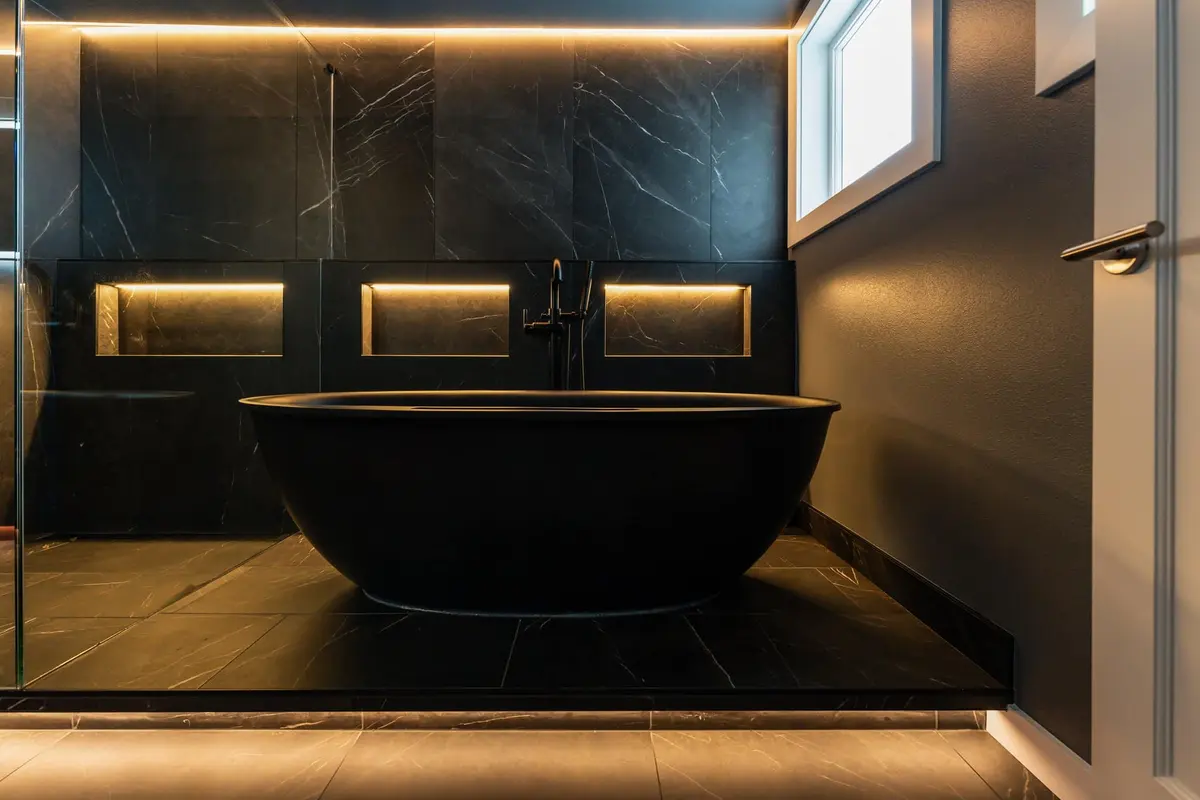
Two of our recent basements show the range. A Finished Basement Remodel in Seattle, WA, completed in July 2024, cost about $120,000: new clothes and storage closets, one light oak-look plank floor through the whole level, and a bedroom suite behind glass-paned French doors. A Black Marble-Look Basement Bathroom in Redmond, WA took about 12 weeks in 2024 and cost about $100,000 on its own. Prices in 2026 start at the figures in the table above.
For carpet in place of plank, read How Much Does Carpet Replacement Cost in the Seattle Area?
How do we handle a basement remodel?
We walk the basement with you, measure it, look for signs of water and note the height under the beams and ducts. Then we lay out the rooms, price every line in writing and file the permit, including any escape window and plumbing work. One project manager runs the framing, rough-ins, inspections and finishes, and walks the finished rooms with you at the end.
See Basement Remodeling Across the Greater Seattle Area for what we build below grade. For remodeling in the city, see Home Remodeling Contractors in Seattle, WA.
Frequently Asked Questions
What if I have a No Trespassing sign or a dog?
The King County Property Field Inspection FAQ (read October 2026) says field staff "will pass no trespassing signs and head directly to the front door to engage the property owner." If dogs are present, staff stay in their vehicle.
Does small basement work need a permit in Seattle?
The Seattle Department of Construction and Inspections Do You Need a Permit? page (read October 2026) says no permit is needed for "minor repairs or alterations that cost $6,000 or less in any 6-month period." Any work on load-bearing supports, or work that reduces egress, light, ventilation or fire resistance, needs one. A basement finish starts at $30,000+, well past that limit.
Does refreshing a basement that is already finished change the assessment?
The law values the property at full market value, so the Assessor decides what changed. Ask the Assessor how your project will be treated.
Who should I ask about my own property tax?
The King County Department of Assessments at (206) 296-7300 or Assessor.info@kingcounty.gov for the record and value of your home, and a tax professional for your bill. We can answer questions about the remodel and the permit.