Basement remodeling, Seattle code
Unfinished Basement Requirements for Living Space in Seattle
Turning an unfinished basement into living space in Seattle requires a building permit and a set of code minimums: a 7 foot ceiling, rooms of at least 70 square feet, window glass or electric light averaging 6 footcandles, permanent heat to 68°F, insulated walls, smoke and carbon monoxide alarms, and an escape opening in every new bedroom.
This guide quotes the 2021 Seattle Residential Code and the 2021 Seattle Energy Code; other cities run their own permit desks. To have your basement measured against these rules, Book a Consultation.
Is an unfinished basement considered living space?
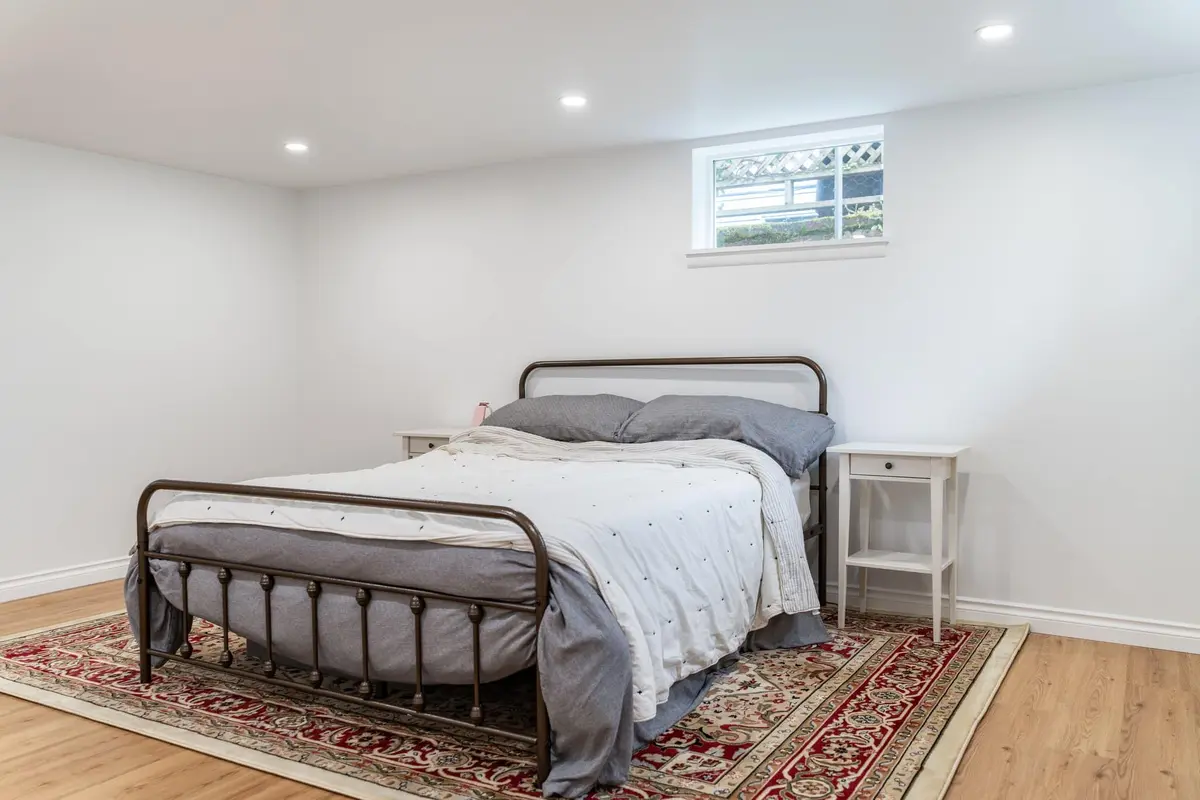
Only once it meets the code minimums for habitable space. Section R202 of the 2021 Seattle Residential Code (Chapter 2, PDF page 12) defines habitable space as "A space in a building for living, sleeping, eating or cooking." It adds: "Bathrooms, toilet rooms, closets, halls, storage or utility spaces and similar areas are not considered habitable spaces."
Until it meets the minimums below, an unfinished basement is storage space in code terms.
What does Seattle code require to turn an unfinished basement into living space?
Nine rules decide whether a basement counts as living space. Eight are in the 2021 Seattle Residential Code, the edition the Seattle Department of Construction and Inspections publishes as its residential code (read October 2026). The ninth, wall insulation, is in the 2021 Seattle Energy Code. Words in quotation marks are the code's own, checked against the SDCI PDFs in October 2026.
| Requirement | Section and PDF page | What the code says |
|---|---|---|
| Building permit | R105.1, Chapter 1 page 6 | A permit before "altering, repairing, moving, improving" a building or "changing the occupancy of" it. |
| Ceiling height | R305.1, page 42 | Habitable space and hallways: "not less than 7 feet". Bathrooms, toilet rooms and laundry rooms: "not less than 6 feet 8 inches". |
| Room size | R304.1 and R304.2, page 42 | Habitable rooms: "not less than 70 square feet" and "not less than 7 feet" in any horizontal dimension. |
| Light | R303.1, page 40 | Glass of "not less than 8 percent of the floor area", or electric light averaging 6 footcandles. |
| Heat | R303.10, page 41 | Heat that holds 68°F in habitable rooms, baths and toilet rooms. Portable space heaters do not count. |
| Escape opening | R310.6, page 50 | In every new sleeping room created in an existing basement. |
| Smoke alarms | R314.2.2 and R314.3, pages 55 and 56 | The whole home gets smoke alarms "as required for new dwellings". |
| Carbon monoxide alarms | R315.2.2 and R315.3, page 57 | Outside each sleeping area and "on each level of the dwelling". |
| Wall insulation | Seattle Energy Code Table R402.1.3, Chapter 4 page 2 | Below-grade walls: "10/15/21 int + 5TB". |
Sources: 2021 Seattle Residential Code, Chapter 1 and Chapter 3; 2021 Seattle Energy Code, Residential, Chapter 4. All published by SDCI and read October 2026; page numbers are PDF pages.
Does a basement room need a window to count as living space?
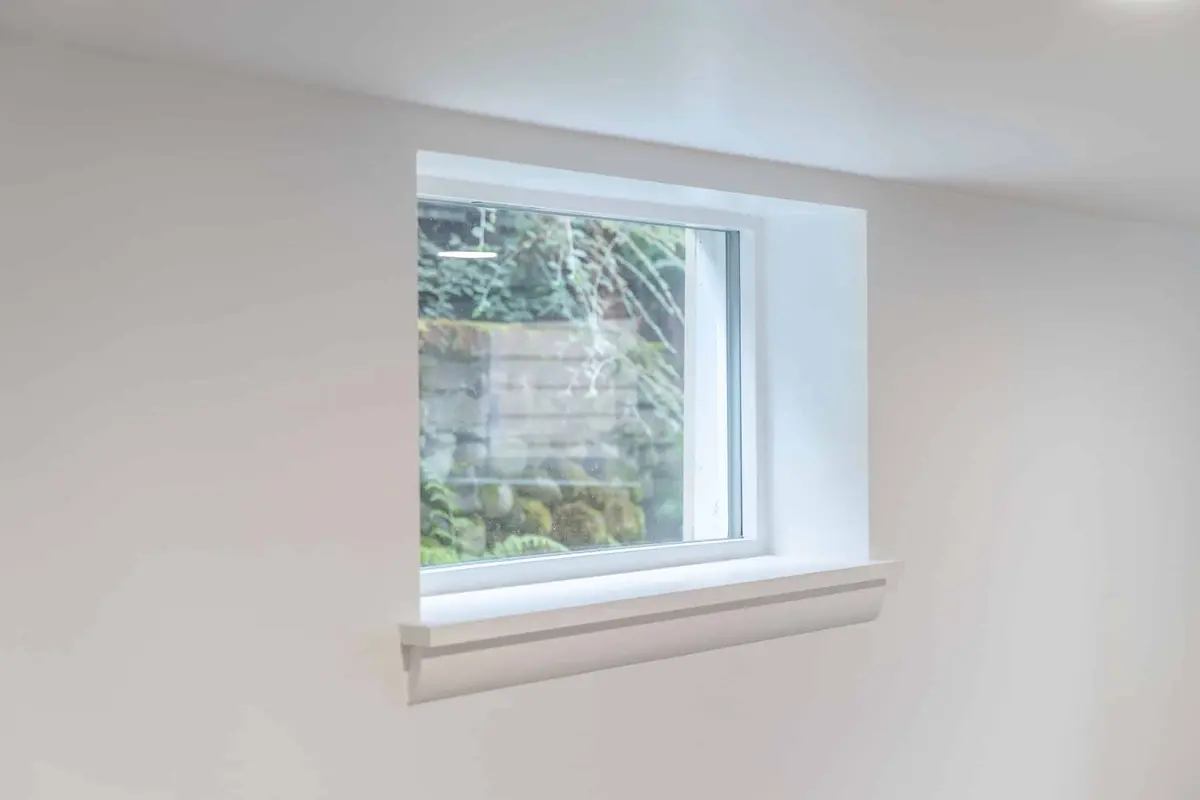
Not always. Section R303.1 asks every habitable room for glass equal to at least 8 percent of its floor area. A 12 by 15 foot family room (180 square feet) needs about 14.4 square feet of glass. Exception 1 gives another route: "The glazed areas need not be installed in rooms where ... artificial light is provided that is capable of producing an average illumination of 6 footcandles (65 lux) over the area of the room at a height of 30 inches (762 mm) above the floor level."
Fresh air is a separate rule. Seattle's edition strikes the openable window rule from R303.1. Section R303.4 says dwelling units "shall be equipped with local exhaust and whole house ventilation systems designed and installed as specified in Section M1505.4." A bedroom is the exception to "no window needed", because it needs an escape opening.
How big must a basement room be to count as a habitable room?
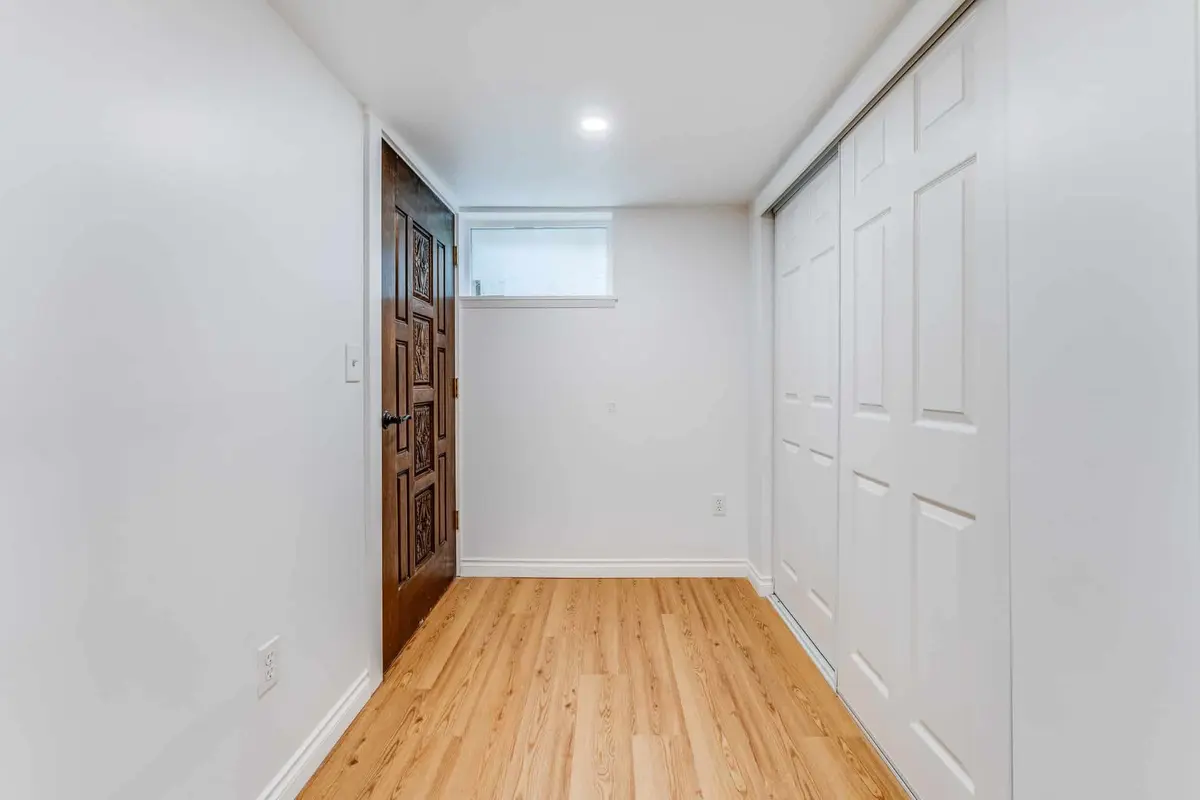
At least 70 square feet and 7 feet across. Sections R304.1 and R304.2 set "not less than 70 square feet" and "not less than 7 feet (2134 mm) in any horizontal dimension" for each habitable room. Kitchens are exempt from both size rules.
Section R304.3 then trims the count. Floor under "a furred ceiling measuring less than 7 feet (2134 mm) from the finished floor to the finished ceiling shall not be considered as contributing to the minimum required habitable area for that room." Where a ceiling is furred down below 7 feet, that strip of floor drops out of the 70 square foot count.
Section R305.1 sets the ceiling at 7 feet for habitable space and hallways, and 6 feet 8 inches for bathrooms, toilet rooms and laundry rooms. The full height rules and the beam exception are in 7 Things You Should Know Before Finishing a Basement.
How warm and how well insulated must a finished basement be?
Warm enough to hold 68°F on permanent heat. Section R303.10 requires heating "capable of maintaining a minimum room temperature of 68°F (20°C) at a point 3 feet (914 mm) above the floor and 2 feet (610 mm) from exterior walls in habitable rooms, baths and toilet rooms at the design temperature as specified in Table R301.2". It adds: "The installation of one or more portable space heaters shall not be used to achieve compliance with this section."
Insulation follows the 2021 Seattle Energy Code, Residential, which SDCI publishes in Chapter 5 for existing buildings (read October 2026). Section R503.1.1 says building envelope assemblies that are part of an alteration "shall comply with Section R402.1.3 or R402.1.5". Table R402.1.3 sets below-grade walls at "10/15/21 int + 5TB". Footnote c reads that as R-10 continuous insulation outside the wall, R-15 continuous insulation inside it, or R-21 in the framed wall plus a thermal break between slab and wall.
Which of those wall builds fits your basement, and what changes when an unheated basement becomes heated rooms, is covered in How to Finish Basement Walls.
Which smoke and carbon monoxide alarms does a basement permit require?
Alarms for the whole house. Section R314.2.2 says that where alterations requiring a permit occur, or sleeping rooms are added, "each dwelling unit shall be equipped with smoke alarms as required for new dwellings." Section R314.3 places them "In each sleeping room", outside each separate sleeping area, and "On each additional story of the dwelling, including basements". Where more than one is required, Section R314.4 has them interconnected so one alarm sets off all of them; listed wireless alarms meet that.
Section R315.2.2 says "Existing dwellings shall be equipped with carbon monoxide alarms in accordance with Section R315.2.1" and adds: "An inspection will occur where alterations, repairs, or additions requiring a permit occur, or where one or more sleeping rooms are added or created." Section R315.3 places them outside each separate sleeping area "and on each level of the dwelling". R315.2.2 lists four exceptions. One reads "Owner-occupied single-family residences legally occupied before July 26, 2009." Ask the inspector whether it covers your house. A combination smoke and carbon monoxide alarm may stand in for a smoke alarm (R314.5).
Does a new basement bedroom need an escape window?
Yes. Section R310.6 says: "New sleeping rooms created in an existing basement shall be provided with emergency escape and rescue openings in accordance with Section R310.1. Other than new sleeping rooms, where existing basements undergo alterations or repairs, an emergency escape and rescue opening is not required."
A family room, office or gym finish needs no new opening. A bedroom does, and the opening has minimum sizes and a well below grade. Our bedroom and bath finish, from $100,000+, includes the egress window and its well.
What does it cost to bring an unfinished basement up to code near Seattle?
A finish without a bath starts at $60,000+ in the Greater Seattle area, and a finish with a bedroom and full bath at $100,000+. Our Cost of a Basement Remodel in the Greater Seattle Area guide, updated October 2026, puts the code items in its Basic tier.
Two of our basement jobs show real figures. Our Finished Basement Remodel in Seattle, WA, completed in July 2024, cost about $120,000 to add closets and one plank floor to a basement a previous owner had mostly finished. Our Black Marble-Look Basement Bathroom in Redmond, WA took about 12 weeks, from February 26 to May 16, 2024, and cost about $100,000. Costs have risen since.
The plank floor on that Seattle job also appears in Reasons to Upgrade Your Flooring: When to Replace Old Floors, which compares floor types for basements and other rooms.
| Scope | Starting at | Code items included | Time on site |
|---|---|---|---|
| Finish without a bath | $60,000+ | Moisture check, framed and insulated foundation walls, code wiring, smoke alarms brought to code | 6 to 10 weeks |
| Finish with a bedroom and full bath | $100,000+ | All of the above, a bedroom with egress window and well, a bath fan vented outside, permit and inspections managed | 10 to 16 weeks |
Source: Cost of a Basement Remodel in the Greater Seattle Area, October 2026, Basic tier. Times are on site, after design and permits. Not included: permit fees, lowering the floor or raising the ceiling, moving the furnace, water heater or main drain, and an electrical panel upgrade.
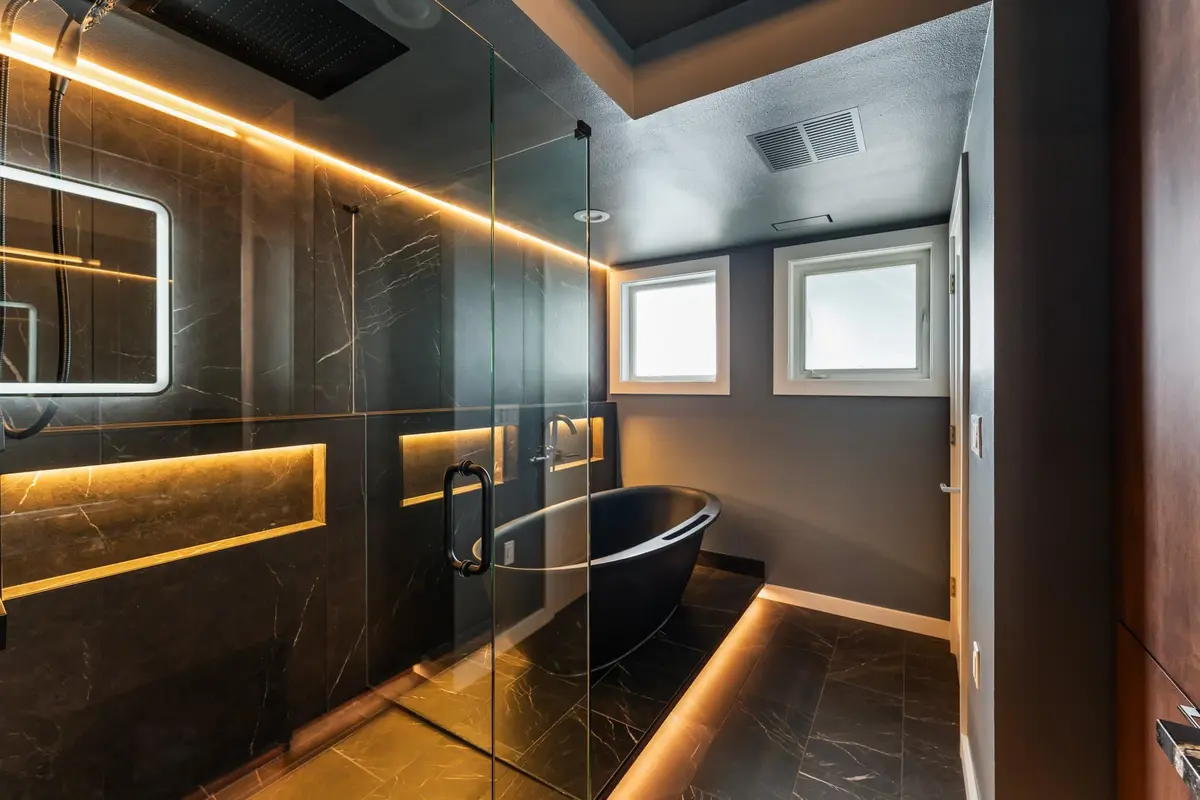
How do we turn an unfinished basement into permitted living space?
We measure the basement, check for water and the height under beams and ducts, then price it in writing and file the permit. One project manager runs the build through final inspection.
A Seattle basement goes through the Seattle Department of Construction and Inspections for the building and electrical permits, with plumbing permitted by Public Health, Seattle and King County. See Basement Remodeling Across the Greater Seattle Area for what we build below grade, and Home Remodeling Contractors in Seattle, WA for our work across the city.
Frequently Asked Questions
Does a basement bathroom need a window in Seattle?
No. Seattle did not adopt the bathroom glass rule: Section R303.3 of the 2021 Seattle Residential Code reads "This section is not adopted." A bathroom still needs a ceiling of at least 6 feet 8 inches. Our bedroom and bath finish includes a bath fan vented outside.
Can the new smoke and carbon monoxide alarms run on batteries?
Yes, when they are added because of a remodel. Section R314.6 says "Smoke alarms installed in accordance with Section R314.2.2 shall be permitted to be battery powered", and Section R315.6 says the same of carbon monoxide alarms installed under R315.2.2.
Can a finished basement become a separate unit?
Often, yes. A separate unit with its own kitchen and entrance is an accessory dwelling unit, which takes a different permit from a finished basement. A legal basement ADU with its own kitchen, entrance and fire separation is priced on our ADU pricing page, starting at $150,000+.